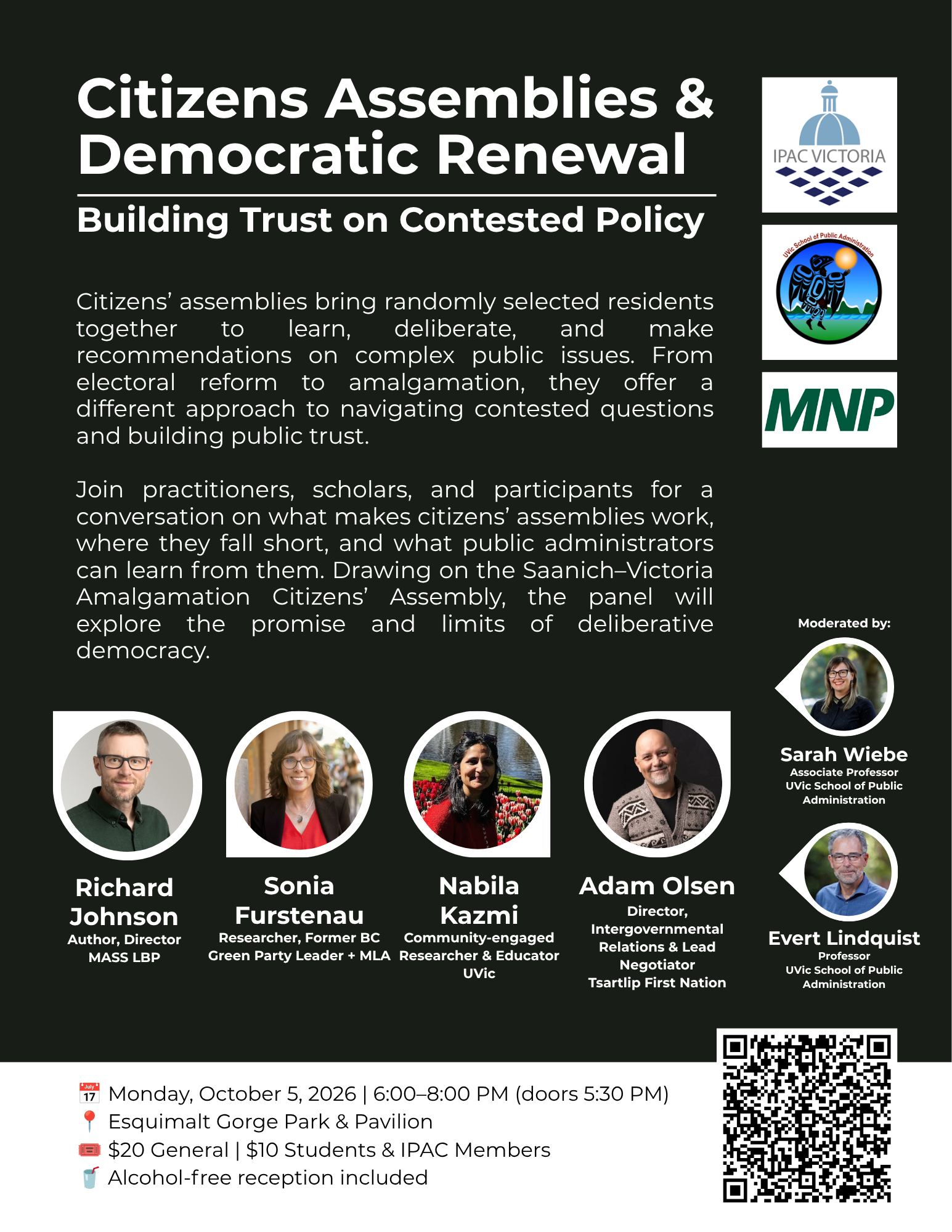

Citizens’ assemblies bring randomly selected residents together to learn, deliberate, and make recommendations on complex public issues. As governments look for new ways to navigate contested policy questions and rebuild public trust, these processes raise important questions like:
What makes a citizens’ assembly effective, and where can the model fall short?
When are citizens’ assemblies a useful complement to traditional public consultation and representative democracy?
How can governments design deliberative processes that are genuinely representative, informed, and trusted by the public?
What can public administrators learn from the experience of citizens, practitioners, and researchers who have participated in these processes?
Drawing on the recent Saanich–Victoria Citizens’ Assembly on Amalgamation and experiences with deliberative democracy more broadly, this panel brings together practitioners, scholars, and participants to explore both the promise and limitations of citizens’ assemblies. Together, they will discuss what these processes can contribute to democratic decision-making and what it takes to make them work in practice.
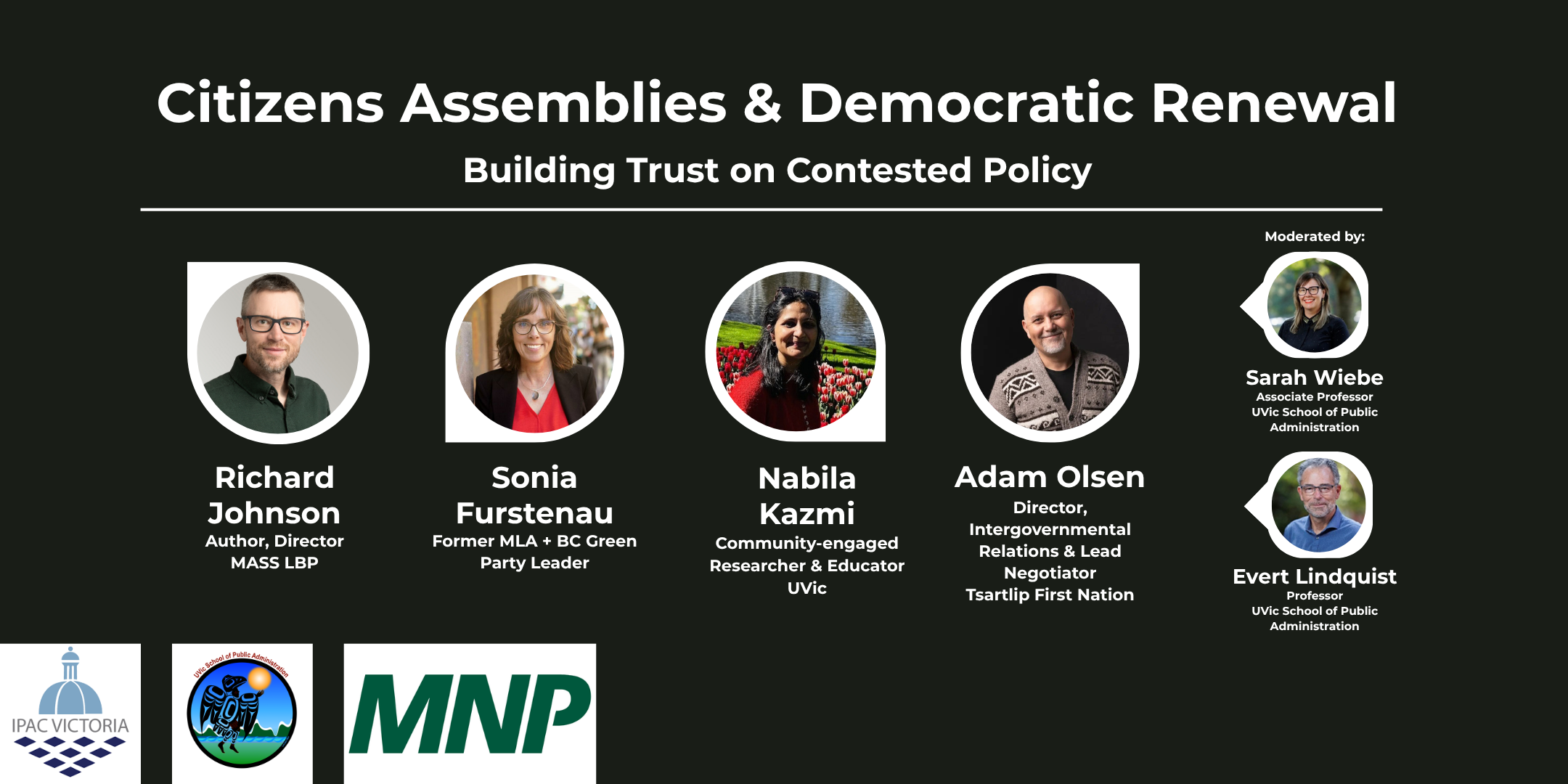
Panelists:
Richard Johnson: Author and Director, MASS LBP
Sonia Furstenau: Researcher, Former BC Green Party Leader and MLA
Nabila Kazmi: Community-engaged Researcher and Educator, University of Victoria
Adam Olsen: Director, Intergovernmental Relations & Lead Negotiator, Tsartlip First Nation
Moderated by:
Sarah Wiebe: Associate Professor, UVic School of Public Administration
Evert Lindquist, Professor, UVic School of Public Administration
Event Details:
📅 Monday, October 5, 2026 | 6:00–8:00 PM (doors open 5:30 PM)
📍 Esquimalt Gorge Park & Pavilion
🎟 $20 General | $10 Students & IPAC Members
🥤 A non-alcoholic reception is included
This event is brought to you by IPAC Victoria and the University of Victoria School of Public Administration, with support from MNP.